12 September 2026
Wine Gift Set Boxes: Packaging a Bottle with Glasses and Tools
A wine gift set box is an insert problem first and a box problem second. Glass stems, a corkscrew and a bottle each need holding differently inside the same cavity, and the box only works once that layout is right. Get the insert wrong and you hear about it from the customer, not the courier.
Why the insert decides the whole set
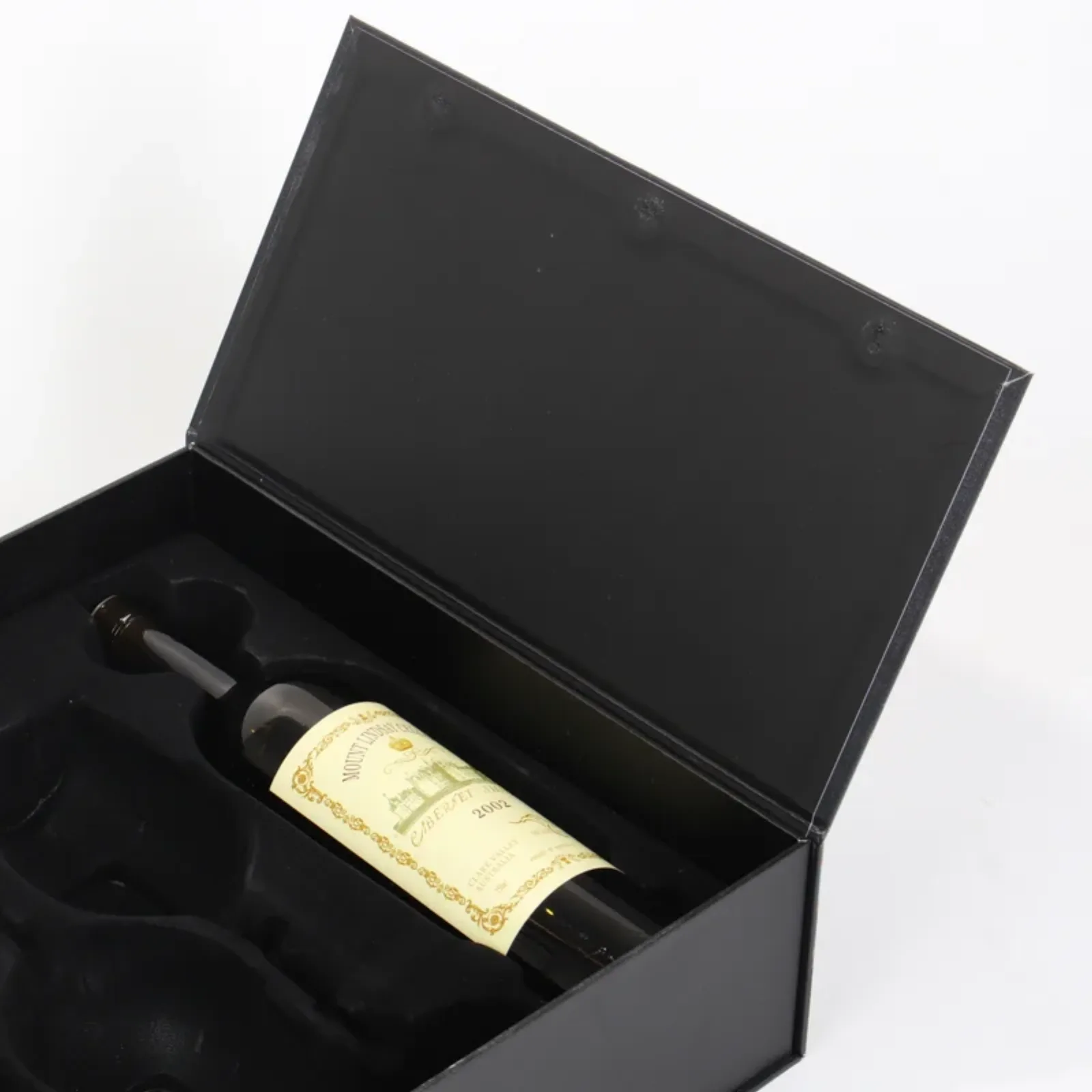
Take our cardboard two bottle wine and glass set box. It measures 365 by 110 by 355 mm, built from 1400 g grey board with 157 g texture paper. Two bottles and the glasses share one footprint, which means the insert has to do three jobs at once: locate the bottles, suspend the stems, and leave a slot for tools. If you start by picking board and print, you'll be back at the drawing stage a week later.
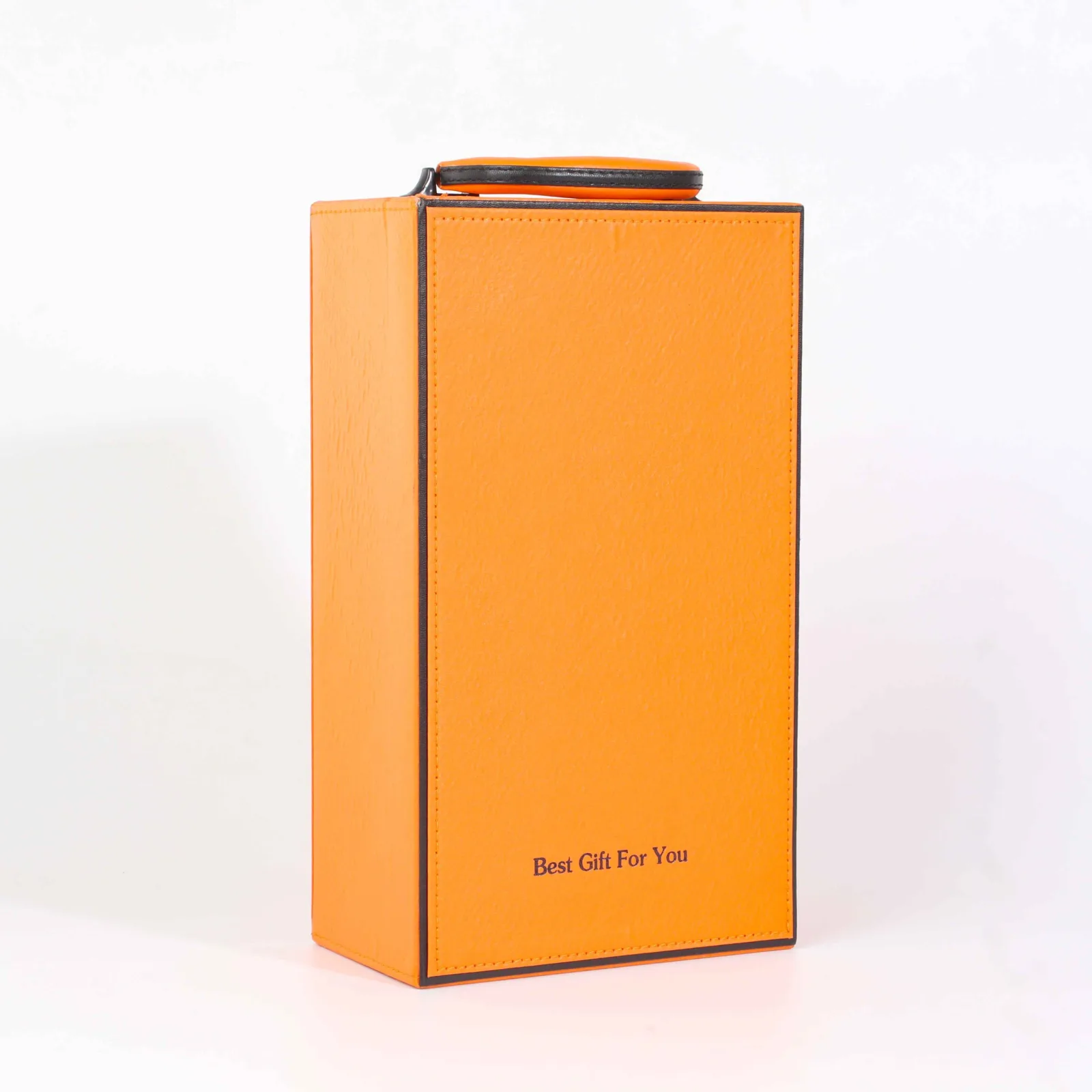
The other one we build often is a leather double bottle box that carries wine utensils. Different skin, same discipline. The bottle doesn't care what the outside looks like. It cares whether the neck and shoulder are supported when the parcel gets tipped on its side at a depot. A set box fails in transit far more often than a single bottle box, simply because there's more loose mass moving around inside.
So the honest verdict: if you only ever ship one bottle, a plain single bottle box is cheaper and easier. A set box earns its keep when the glasses and tools are part of what you're selling, and the unboxing is the point. For that wider picture, our guide to gift packaging for wine bottles covers boxes, bags and sets together.
Where the glasses sit
Stems are the part buyers underestimate. A wine glass left hanging by the bowl alone will flex in transit, and a hairline crack at the joint shows up after delivery, not before. Support the bowl and the foot both. Two contact zones per glass, and the glass shouldn't rattle when you tap the closed box with a knuckle.
Placement matters too. Glasses go beside the bottle, never above the neck. Above the neck is where the box gets squeezed first when cartons stack, and a stem lying across a bottle shoulder is a lever waiting to snap. On a one bottle, two glasses layout, run the glasses parallel to the bottle and keep the stems pointing the same direction, so the whole set reads as one line when the lid comes off.
For two bottles with tools, the layout changes shape. Bottles go to the two long sides, glasses or tools take the middle channel, and the tools sit in cut slots rather than a loose pocket. A corkscrew rolling across a bottle during a 1.2 m six face drop test is how you get a chipped shoulder.
Matching the insert to what's inside
We work with four insert types: velvet tray, EVA foam, blister and paper mould. For glass, EVA foam and velvet trays are the usual answer because both can be cut to the exact silhouette of the object. The tray gives you the soft touch on the unboxing, the foam gives you the tighter hold. Blister suits tools and small accessories where you want a crisp, thin profile. Paper mould works when weight and material mix matter more than a precise glass fit.
The bottle rule doesn't change because it's a set. Four point hold, no unsupported neck or shoulder. Our control tolerance on the insert is plus or minus 1 mm, and we check it the same way every time: shake for 10 seconds with no movement, tilt to 45 degrees with no slide, invert with no release. If the glasses shift during the invert check, the insert is wrong, not the box.
One trade off worth naming. A very tight glass cavity protects well but can be awkward for the person opening the gift, especially if they're holding it one handed. Slightly looser with a felt or velvet contact surface often reads better in the hand. That's a judgement call, and it's one you should make with a sample in front of you rather than on a screen.
Board weight and structure
Our board standard is 1200 g grey board minimum, with 1400 g recommended for spirits. The two bottle glass set box above already uses 1400 g, and that's not an upsell. A set carries more than a single bottle, so the walls take more load from the inside as well as the outside. Facing paper runs 157 g minimum, specialty or coated. We don't use recycled grey board and we don't use high moisture paper, because both show up later as warping on a lid that used to sit flat.
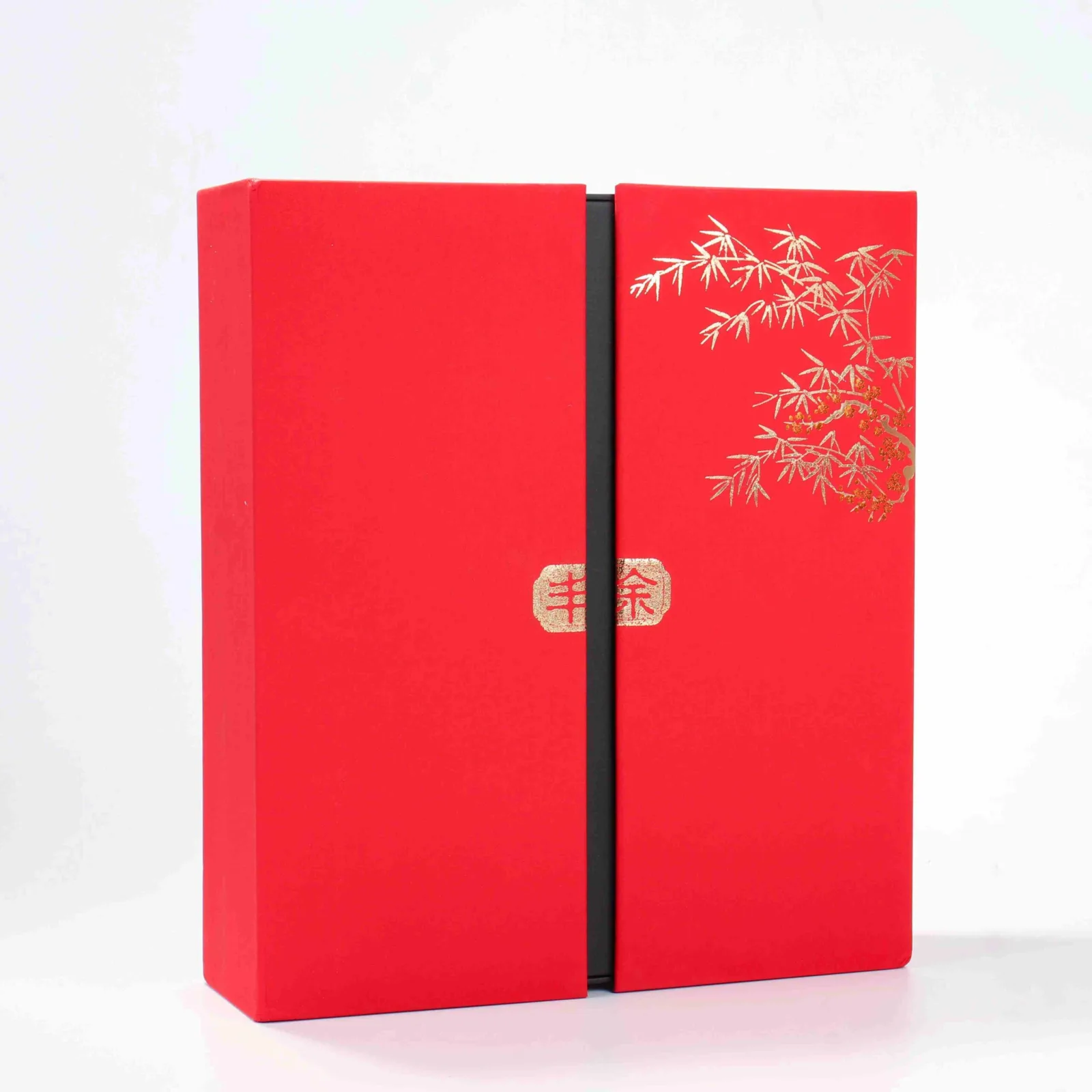
Structure is where the gifting side and the shipping side meet. Rigid lid and base is the classic presentation box. Magnetic closure gives you a lid that holds itself shut and opens with one hand. Double door opens outward and lays the set flat, which is a strong reveal for two bottles. We build that format as a two bottle double door presentation box, and it's a good fit when the recipient is meant to see everything at once.
Foldable is the other option, and it's the one to pick when storage and freight volume drive the decision. Our control tolerance there is different: creases must not crack, magnet position plus or minus 1 mm, corners 90 degrees when erected. Set boxes are heavier than a plain gift box, so a foldable set box needs the crease right the first time.
When a bag is the better answer
Not every set needs a rigid box. If the wine, glasses and tools already come in their own retail cartons, a matching paper bag does the gifting job at lower cost and in less space. We make box and bag sets where the bag is built to match the box print, which keeps the shelf and the handover consistent.
The catch is protection. A bag gives you no drop protection and no stacking strength, so it only works when the contents are already boxed. If your glasses travel loose, a bag is the wrong call. If they're in a moulded inner tray already, the bag is often the smarter spend.
Leather changes the conversation again. A leather set box signals a higher price point and it ages in a way paper doesn't, but it's a heavier object and it shows scuffs. Look at our leather wine gift boxes if that's the direction, and compare against the double bottle wine gift boxes before you commit. Both hold two bottles. They sell to different buyers.
Colour, print and the unboxing
Set boxes usually carry more print than a single bottle box, because the lid is bigger and the brand story has room. Pantone matching, first article approval and mid run sampling are how we hold it. Black, deep blue and burgundy are the hardest to hold across a run, so if your brand colour sits in one of those, expect to look at more proofs rather than fewer.
Inside finish is where gifting buyers win or lose. A printed inner lid, a ribbon pull, a velvet tray in a contrasting tone: these are the details that make someone keep the box instead of binning it. None of them change how the bottle is held, so decide the protection first and the finish second. For more on that balance, our corporate gifting packaging ideas go through it from the buyer's side.
One more failure mode. A set box with a heavy tool, a corkscrew or a pourer, needs that tool held as firmly as the bottle. Tools are small and dense, so they punch through a soft insert. Give them their own cut slot with a lip, or put them in a blister. A loose corkscrew in a gift box is the fastest way to scratch a glass.
What to send us
We need the bottle, the actual glasses and tools, the quantity and a reference design. Send the physical items where you can. A drawing of a glass rarely matches the glass, especially at the foot and the joint, and those are the two points that decide whether the insert holds. If you can't ship them, send the bottle and exact glass model details, and we'll work from a blank sample first.
Blank sample for structure, printed sample for the visual. That order saves everyone a round. We're an OEM and ODM manufacturer of wine boxes and wine bags, founded in 2014 in Yiwu, with customers in over 30 countries, and we handle design support, structure development, material selection, printing and finishing. Email [email protected] to start.
And if your set is really one bottle and one glass, say so. Sometimes the right answer is a smaller box, not a bigger insert.
Key points
- A set box is an insert problem first: locate the bottle, support the stems, cut slots for tools.
- Support glass at the bowl and the foot, never let a stem hang free in transit.
- 1400 g grey board suits a set box because it carries more mass than a single bottle.
- EVA foam and velvet trays cut to the exact silhouette give the tightest hold on glass.
- Send the real glasses and tools. A drawing won't show the foot or the joint.
Questions buyers ask
Can one box hold a bottle, two glasses and a corkscrew?
Yes, and we build that layout often. The bottle takes a four point hold, the glasses sit beside it with the bowl and foot supported, and the corkscrew goes in its own cut slot rather than a loose pocket. Everything gets checked with the shake, tilt and invert test before it ships.
Why is 1400 g board used for a set box instead of 1200 g?
Because a set carries more than a single bottle. Our board standard starts at 1200 g grey board, and 1400 g is what we recommend for spirits. The two bottle wine and glass set box we build uses 1400 g for that reason, since the walls take more load from inside and outside.
Should I choose a rigid box or a foldable one for a gift set?
Rigid lid and base, magnetic closure and double door give the strongest reveal and the most protection. Foldable saves storage and freight volume, but the creases must not crack and the corners have to stand at 90 degrees. Pick foldable when volume drives the decision, rigid when the unboxing does.
Send us the bottle, the glasses, the tools and a reference design, and we'll work up the insert layout and a blank sample for the set box. Get a Quote
Put this on your bottle
Send the bottle sample or dimensions, quantity and a reference design. We reply with structure options and pricing.
- Email[email protected]